Published Updated
Check whether this matches your current buying, selling, or location decision.
Scan the key points first, then decide whether to read the full analysis.
What is the monthly payment on a $1.5 million home in the Bay Area?
Almost every buyer asks whether they should wait for rates to drop. I cannot forecast rates and neither can anyone selling you a forecast. What I can...
Rates moved again, and the number that matters to you is not the headline percentage. It is what that percentage does to the payment you can carry every month for the next several years.
A rate change moves your buying power immediately and quietly, well before it shows up in listing prices. The useful response is not to guess where rates go next, but to know exactly what today's rate does to the payment you can carry.
Almost every buyer asks whether they should wait for rates to drop. I cannot forecast rates and neither can anyone selling you a forecast. What I can do is show you the arithmetic in both directions, including what happens to competition if rates do fall.
You might be wondering
If any of these sound like you, this guide was written for you.
- What is the monthly payment on a $1.5 million home in the Bay Area?
- How much income do I need to buy a $1 million home?
- Should I wait for mortgage rates to fall before buying?
- How much does a 1% rate change affect my payment?
- What is the current 30-year mortgage rate?
Visual Context
Make the decision easier to see

The home itself
Look at space, condition, maintenance, and resale before only reacting to photos.

First impression
Curb appeal and presentation set expectations before anyone walks inside.

The long hold
Think about who lives here in five years, and who buys it after you.
Read market news in layers
Market headlines only matter after they connect to your city, budget, and property type
-
Start here Headline
Check whether the news is statewide, Bay Area-wide, or specific to your city and price lane.
-
Supply
Low inventory does not mean every home is strong. Ask whether good homes are truly scarce.
-
Demand
Buyer speed depends on price, condition, location, and confidence.
-
Action
Bring the story back to whether you should wait, tour, offer, or sell.
-
By this point you are ahead of most
What is the current 30-year mortgage rate?
Freddie Mac's Primary Mortgage Market Survey put the 30-year fixed average at 6.66% for the week ending July 30, 2026. That was up from 6.58% the prior week, the fourth consecutive weekly increase, and the highest reading in about a year.
Survey averages are a benchmark, not a quote. Your actual rate depends on credit, down payment, loan size, property type, occupancy, and whether you pay points. In the Bay Area, jumbo pricing often differs from the headline number in both directions.
What is the monthly payment on a Bay Area home at 6.66%?
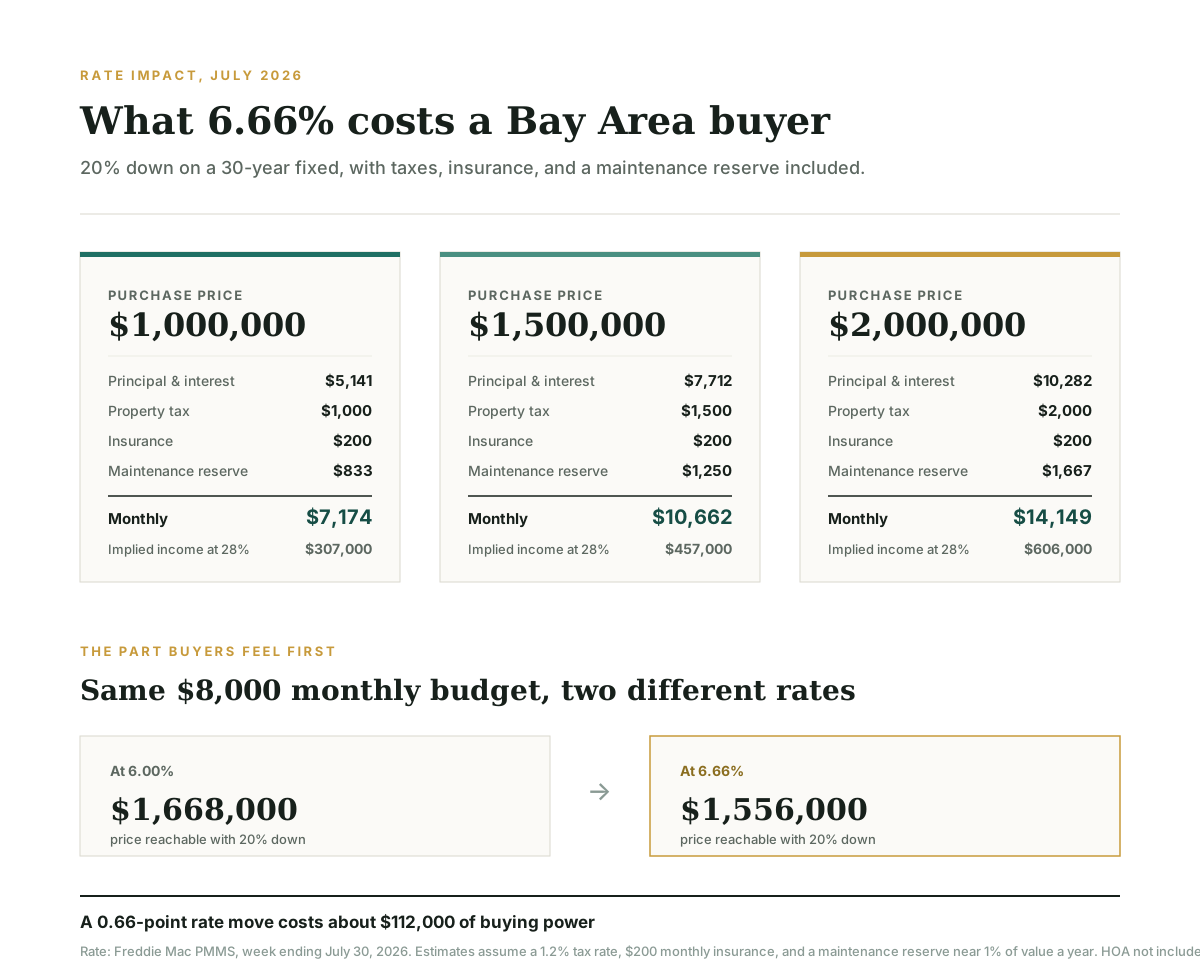
Here is the arithmetic at three common Bay Area price points, assuming 20% down on a 30-year fixed, a 1.2% property tax rate, $200 a month for insurance, and a maintenance reserve near 1% of value a year. HOA dues are not included, so condo and townhome buyers should add theirs.
The pattern worth noticing: principal and interest is only about 70% of the real monthly cost. Budgeting from a lender's quoted payment alone understates what the home actually asks of you each month.
| Purchase price | Down payment | Principal & interest | Tax + insurance | Maintenance | Total monthly | Gross income at 28% |
|---|---|---|---|---|---|---|
| $1,000,000 | $200,000 | $5,141 | $1,200 | $833 | $7,174 | $307,000 |
| $1,500,000 | $300,000 | $7,712 | $1,700 | $1,250 | $10,662 | $457,000 |
| $2,000,000 | $400,000 | $10,282 | $2,200 | $1,667 | $14,149 | $606,000 |
Planning estimates, not a loan quote. Your rate, tax rate, insurance, and HOA will differ by property and lender.
How much income do you need to buy at these prices?
Using the common 28% guideline, a $1,000,000 purchase implies roughly $307,000 of gross income, $1,500,000 implies about $457,000, and $2,000,000 implies about $606,000.
Treat those as orientation, not gatekeeping. The guideline knows nothing about your other debt, childcare, family help with a down payment, or how stable your income is. Two households with identical W-2 income can have very different real capacity.
This matters especially for tech compensation. If a meaningful share of your income is RSUs or bonus, lenders will look at vesting history and consistency, and your own planning should be more conservative than a base-salary buyer's, because that income can move with your employer's stock.
How much does a rate change actually affect your payment?
On a $1,500,000 purchase with 20% down, principal and interest at 6.00% is about $7,195. At 6.66% it is about $7,712. That is roughly $517 more a month, about $6,200 a year, and around $186,000 across a full 30-year term.
The more useful way to see it is in reverse. Hold your budget fixed at $8,000 a month of principal and interest. At 6.00% that reaches a purchase price near $1,668,000 with 20% down. At 6.66% the same budget reaches about $1,556,000. The rate move quietly removed roughly $112,000 of house.
Should you wait for mortgage rates to fall?
I cannot tell you where rates go, and I would be careful with anyone who says they can. What I can describe is the tradeoff honestly.
If rates fall meaningfully, your payment on the same house improves. But lower rates also restore purchasing power for every other buyer who was sitting out, and in a supply-constrained market that competition tends to show up as higher prices, faster sales, and more offers per listing. You may win on the rate and lose on the price, plus you compete against more people for the same home.
There is also a middle path people forget: you can buy at today's rate and refinance later if rates drop. That is not free, and it is not guaranteed, but it means the decision is not strictly wait-or-not. What you cannot get back is a home that sold to someone else.
What to do before you shop at this rate
Refresh your pre-approval. If yours is more than a few weeks old it was written against a lower rate, and the price range in it is no longer real. Ask your lender for payment figures at your target price, one step above, and one step below.
Then decide two numbers before you tour: the payment you are comfortable carrying every month, and the absolute ceiling you will not cross. Doing that in a quiet room is far easier than doing it after you have fallen for a house.
Free payment reality check
Want these numbers run for your actual budget?
Send me your target cities and rough budget. I will reply with what the true monthly payment looks like at today's rates, the cash you need beyond the down payment, and the one or two things to verify before you tour. No sign-up, no pressure.
Faster: text or call 510-813-3293, or WeChat Adam1Chen.
Related Local Guides
Sources and Credits
- Freddie Mac Primary Mortgage Market Survey30-year fixed average of 6.66% for the week ending July 30, 2026.
- CFPB guidance on how much home you can affordBackground on payment-to-income guidelines and loan comparison.