
Published Updated
Check whether this matches your current buying, selling, or location decision.
Scan the key points first, then decide whether to read the full analysis.
Is it a buyer's market in the Bay Area right now?
Clients keep asking me whether the market has finally turned. My honest answer is that the question is too broad to answer usefully. What I can do is...
Buyers keep asking whether the market has finally shifted in their favor. The honest answer is that the Bay Area is not one market, and the regional headline will not tell you what to do about the specific house you are standing in.
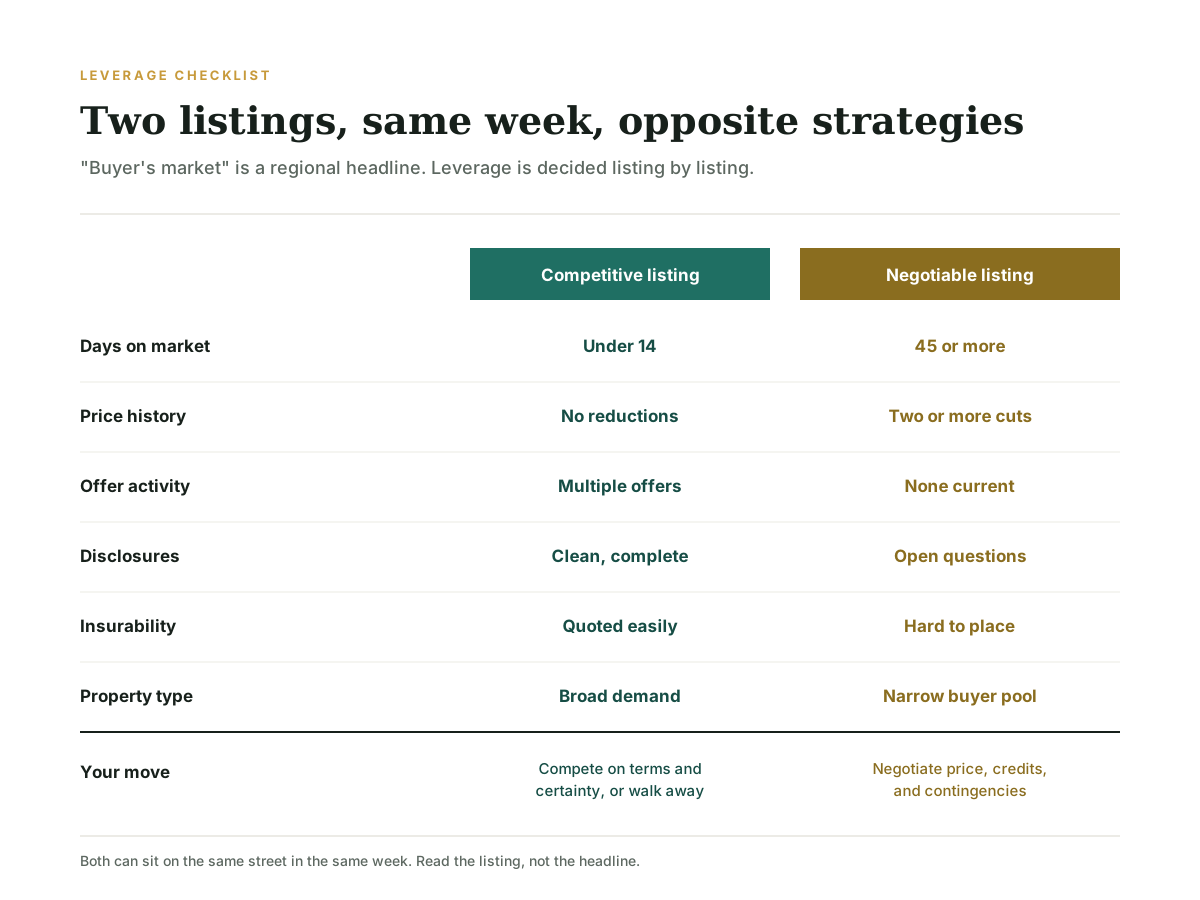
There is no single Bay Area market to have leverage in. Within the same week and the same county, one listing can take multiple offers over asking while another sits with two price cuts and no activity. Leverage is a property-level question, not a regional one.
Clients keep asking me whether the market has finally turned. My honest answer is that the question is too broad to answer usefully. What I can do is read a specific listing and tell you whether you have room to negotiate, and that reading comes from a short list of signals anyone can check.
You might be wondering
If any of these sound like you, this guide was written for you.
- Is it a buyer's market in the Bay Area right now?
- How much can I negotiate off asking price?
- How do I know if a listing is negotiable?
- Are Bay Area home prices falling in 2026?
- Should I wait for prices to drop before buying?
Visual Context
Make the decision easier to see

Condition tells a story
Maintenance history hints at what the next owner will inherit.
What you are buying
A home is the structure, the lot, the systems, and the obligations together.

Commute reality
BART, Caltrain, bridges, and freeways change the cost of daily life.
Read market news in layers
Market headlines only matter after they connect to your city, budget, and property type
-
Start here Headline
Check whether the news is statewide, Bay Area-wide, or specific to your city and price lane.
-
Supply
Low inventory does not mean every home is strong. Ask whether good homes are truly scarce.
-
Demand
Buyer speed depends on price, condition, location, and confidence.
-
Action
Bring the story back to whether you should wait, tour, offer, or sell.
-
By this point you are ahead of most
Is it a buyer's market in the Bay Area right now?
The regional data genuinely moved. The California Association of Realtors reported a statewide median of $904,640 in June 2026, down 2.8% from May's record $930,260 and only 0.4% above June 2025. More striking for us: the San Francisco Bay Area was the only California region that posted no annual increase in median price at all, with the figure essentially flat against a year earlier.
That is a real change from the last several years, and it is the strongest argument that some buyers have more room than they did. But flat is an average, and averages hide the thing you actually need to know.
Why did Bay Area sales rise while prices stayed flat?
Bay Area sales were up 7.8% year over year in the same report. More homes changed hands, and the median did not move. That combination usually means the mix of what sold shifted, not that every home lost value.
When more mid-tier and entry-level homes close, the median can hold flat even in neighborhoods where well-prepared homes are still competitive. A flat median is compatible with one street seeing four offers and another seeing none.
How do rates at a one-year high change what you can pay?
Freddie Mac's 30-year fixed average reached 6.66% at the end of July 2026, up from 6.58% the prior week and the fourth consecutive weekly increase. That is the highest reading in a year.
Rate moves show up in buying power before they show up in prices. A payment that worked in the spring may not clear the same bar now, which is one reason some listings are sitting longer even where demand looks healthy. If you were pre-approved more than a few weeks ago, the number you were given is probably out of date.
Which Bay Area listings are actually negotiable?
This is where the regional headline stops helping and a checklist starts. Six signals tell me most of what I need to know before advising a client to push on price or to prepare for competition.
None of these signals is decisive alone. A home with 60 days on market in a desirable pocket may simply have launched at the wrong price and still attract competition once it corrects. What matters is how many signals point the same direction.
- Days on market: under about two weeks usually means the seller has no reason to negotiate. Past 45 days, the conversation changes.
- Price history: one reduction can be a correction. Two or more, especially close together, signals a seller adjusting to real feedback.
- Offer activity: ask the listing agent directly how many offers they have and whether any fell through. A fallen-out offer often means an inspection or appraisal problem worth understanding.
- Disclosures: unresolved permit, foundation, drainage, or sewer issues shrink the buyer pool, and a smaller pool is where leverage lives.
- Insurance: if a property is difficult or expensive to insure, some buyers cannot close on it at all. Quote insurance before you write, not after.
- Property type and location: condos with high HOA dues or pending assessments negotiate differently than well-located single-family homes.
Why 'buyer's market' is the wrong frame for the Bay Area
National coverage this summer has emphasized more price cuts and slower sales. Some of that is genuine and some is ordinary summer seasonality. Either way, it describes a national average that includes markets nothing like ours.
San Francisco has been running in the opposite direction, with prices posting some of their strongest gains in years on the back of AI-driven demand. A buyer reading national headlines and expecting to negotiate 10% off a well-priced San Francisco home is going to lose that house and be confused about why.
So I would retire the question of whether it is a buyer's market. The useful question is narrower: on this listing, in this condition, at this age on market, do I have room?
What should you do before writing an offer this summer?
Refresh your pre-approval against current rates so the payment you are planning around is real. Then evaluate each home on its own signals rather than on how the market feels.
If the signals say competitive, compete on terms and timing rather than assuming price alone wins, and know your walk-away number before you start. If the signals say negotiable, negotiate on price, credits, and contingencies together instead of only on the number. A repair credit or a rate buydown can be worth more than the discount you were going to ask for.
Free payment reality check
Want these numbers run for your actual budget?
Send me your target cities and rough budget. I will reply with what the true monthly payment looks like at today's rates, the cash you need beyond the down payment, and the one or two things to verify before you tour. No sign-up, no pressure.
Faster: text or call 510-813-3293, or WeChat Adam1Chen.
Related Local Guides
Sources and Credits
- C.A.R. June 2026 home sales and price reportStatewide median of $904,640 and the Bay Area as the only region without an annual price increase.
- Freddie Mac Primary Mortgage Market Survey30-year fixed average of 6.66% for the week ending July 30, 2026.
- Redfin San Francisco County market dataSan Francisco price and competition trends used for the local contrast.